New technologies require new solutions.
We develop assembly systems that make your innovations possible in the first place and keep them performing at the highest level. Precise, efficient and tailored to your individual requirements – even when your product is manufactured in many variants.
Our turnkey systems are designed to provide optimum support for your most demanding processes and unlock growth potential.
Are you facing the challenge of making your production more efficient, flexible and cost-effective?
Are you looking for a solution that not only increases your output, but also takes the quality of your products to a new level?
With the custom assembly systems from esmo automation, you can secure a decisive competitive advantage.
We do not just plan, develop and build a machine for you. We create a customised production solution that is perfectly tailored to your products, processes and objectives.
Your production process is at the centre of our work — not the individual component. From the initial discussion through to commissioning, we work closely with you and maintain close feedback loops throughout every phase of the project.
Since 2001, leading companies in the semiconductor industry, battery manufacturing, laboratory automation and general manufacturing have trusted our expertise in custom machinery.
You, too, can benefit from high-performance, cost-effective assembly systems that future-proof your manufacturing operations.
Variant diversity is considered difficult to manage in assembly automation. Anyone who underestimates it ends up with a system that has to be retooled or modified every time the product changes — and whose cost-effectiveness ultimately suffers as a result.
This is precisely where our core expertise lies: esmo automation assembly systems can handle many product variants on a single machine — often in-line, without modifications and without changing tools. What others classify as “not suitable for automation”, we solve with our modular concepts.
This makes your investment future-proof: The same variant concept can often also be used to accommodate subsequent product updates on the same system. Instead of investing in new equipment for every product generation, you can further develop your existing assembly system.
What does this look like in practice? For an international automotive supplier, our systems assemble and inspect different types of reversing sensors on a single line — including type-specific packaging in different trays, with cycle times of 3.5 to 4.2 seconds per sensor.
You can find this and other projects in our assembly system reference projects »
An investment in automation is a strategic decision.
That’s why from the very beginning we focus on what matters most to you: your success.
Instead of just listing technical data for you, we show you what specific benefits you can expect.
Every manual activity, every unnecessary process step costs time and money.
Our fully automatic and semi-automatic assembly systems are designed to optimise your processes.
The market is changing rapidly, product life cycles are getting shorter.
Your assembly system must be able to keep up. Our modular and scalable concepts give you the necessary agility
Quality is no coincidence, but the result of precise and controlled processes.
We integrate state-of-the-art testing and measurement technology directly into the assembly process.
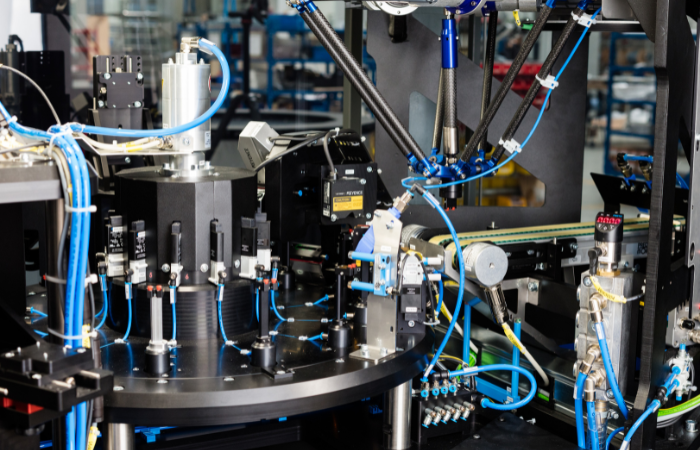
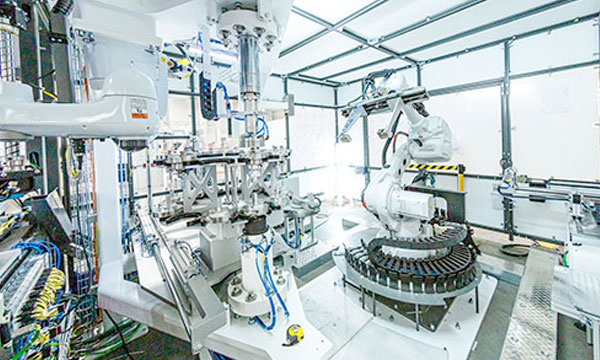
Assembly systems are machines that automatically combine individual components to create functional assemblies or finished products. Depending on their design, they handle the feeding and singulation of parts, the actual joining process, as well as inspection, marking and packaging. They are also referred to as assembly automation systems or assembly machines. At esmo automation, such systems are developed as custom machinery — designed around your product and process, rather than a catalogue standard.
The most economical level of automation depends on production volumes, cycle times and the range of variants. Partially automated assembly cells make sense when production volumes are still growing or individual process steps require human dexterity. Fully automated assembly systems demonstrate their strengths with high production volumes and short cycle times — reproducibly, with full documentation and around the clock. With us, the transition does not result in a system discontinuity: Our systems are designed on a modular basis, allowing you to start with partial automation and upgrade to full automation at a later stage.
The configuration follows the required production volume: An assembly cell operates as a compact stand-alone unit for individual process steps. When several stations are connected via transport systems and workpiece carriers, the result is a linked assembly system — extending all the way to an assembly line that maps every step from feeding through to packaging in a continuous flow. We implement all three configurations and design the interlinking so that material flow, cycle time and the range of variants are aligned.
An assembly system is only as good as its ease of operation in everyday use. That is why we define a clear principle for every system: The operator manages the variant, not the programmer — and the documentation is updated automatically.
A key advantage of full-service mechanical engineering is continuity across the entire process. Design, mechanical manufacturing, software development, assembly and commissioning work seamlessly together. Decisions are not made in isolation, but always with the future operation of your machine(s) in mind. This increases technical quality – while reducing the need for later adjustments or maintenance.
No matter how complex your product is – we develop the right solution. Our many years of experience in special machine construction for assembly systems enable us to understand and meet the specific requirements of demanding industries.
In the semiconductor industry, battery manufacturing and laboratory automation – but of course also in any manufacturing company – highest precision and absolute process reliability are essential. Our assembly systems are designed to perform reliably in these demanding environments. We deliver highly precise and linked assembly systems that guarantee smooth material flow and production at the highest quality level.
Standard solutions rarely suit unique products. Our passion is custom machinery.
We combine proven technologies with innovative ideas to create an assembly system that precisely meets your requirements.
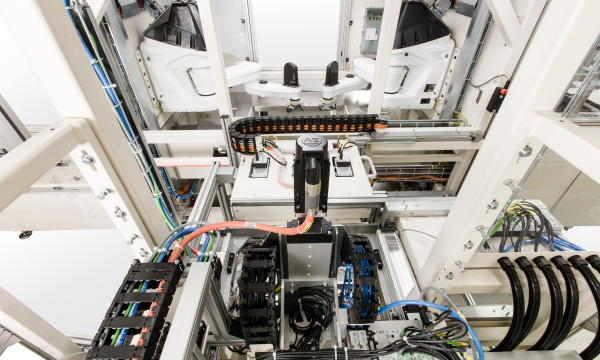
With our Unicell modular concept, we standardise custom machinery wherever it benefits you — simplifying operation and maintenance while retaining complete freedom in the process.
Everything is manufactured under one roof: our milling, control cabinet construction and software development teams work closely together in-house.
We have expertise in a wide range of manufacturing processes:
A successful assembly system is more than the sum of its parts.
It is the result of a collaborative partnership and a holistic approach that extends from the initial idea to after-sales service.
The foundation for success is laid during the planning phase. Together with you, our experts analyse your future requirements, the maturity of your product and the conditions at your production site.
Using methods such as “Design for Assembly” and “Simultaneous Engineering”, we ensure at an early stage that your product design and the automation process are optimally aligned.
And if we are convinced that we are not the right partner for your project, we will tell you honestly.
During the design and construction of your assembly system, we use state-of-the-art tools. By digitally simulating the entire system, we can validate process sequences before the actual assembly takes place.
This virtual commissioning significantly reduces the actual commissioning time at your site and gives you maximum planning certainty.
We support you not only through to the handover of the system, but also during the ramp-up of your series production. With structured training, we prepare your employees to work with the new technology.
From delivery onwards, our systems are designed to keep on-site assembly times to a minimum: Our machine concepts can be divided into sections and are delivered to you by standard truck — without the need for special transport. We deliver worldwide to the kerbside, including customs clearance and shipping arrangements.
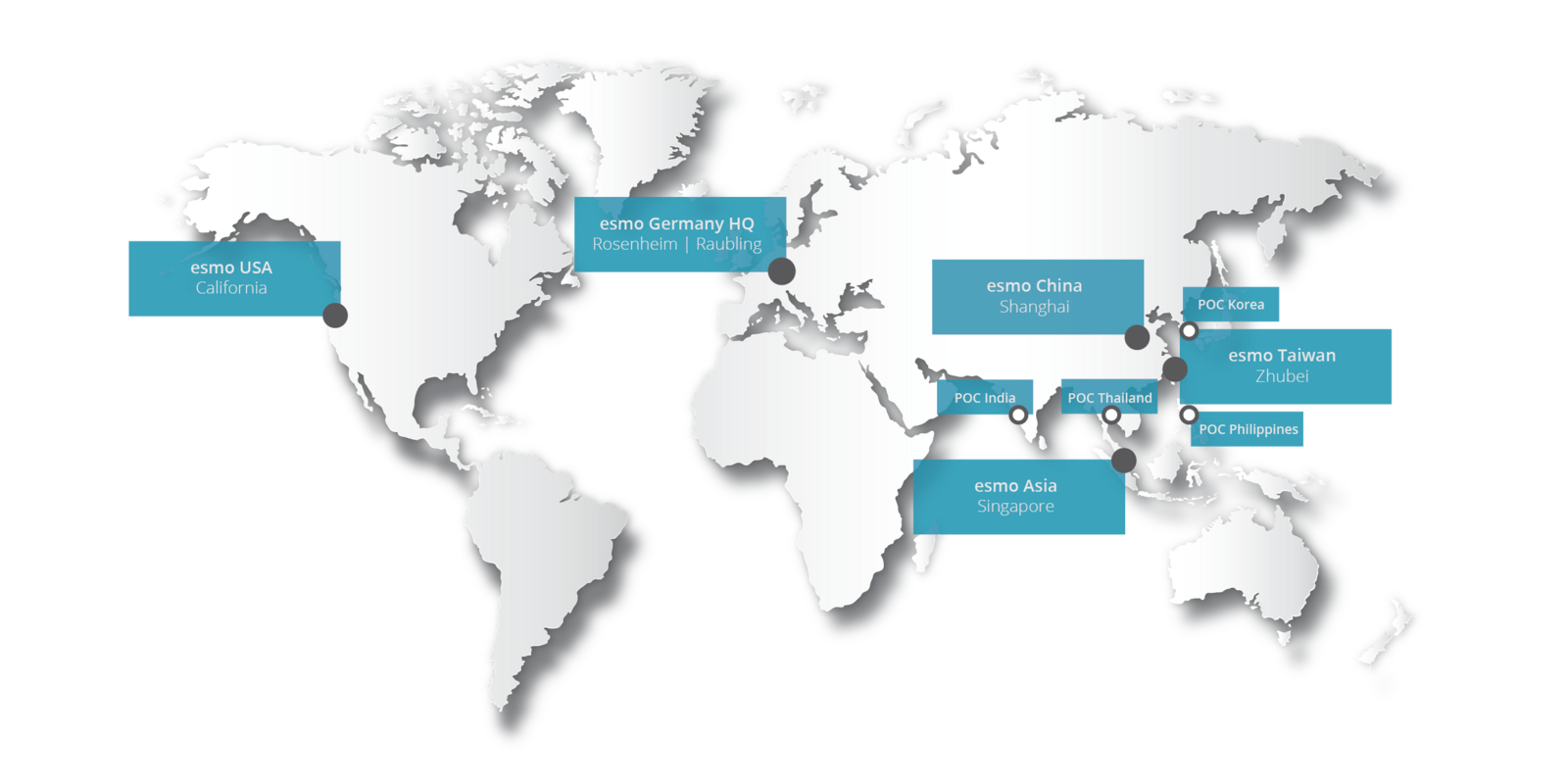
And we continue to support you afterwards: Our global service ensures that your assembly systems deliver high availability and outstanding performance throughout the entire machine life cycle.
Invest in a future with more efficient, flexible and higher-quality production.
Tell us about your project, and let us develop the perfect solution for your assembly together.
Request your individual solution for assembly systems from us now »
Automated assembly systems are your key to greater competitiveness. They enable you to permanently reduce production costs by reducing manual, error-prone processes. At the same time they significantly increase your output and product quality. The result for you: a more economical production, more satisfied customers and a stronger market position.
An assembly system from esmo automation reduces your costs on several levels. It reduces the need for expensive manual interventions, minimises expensive scrap through highest precision and optimises the material flow. Through high efficiency you produce more in less time, which directly reduces your unit costs and increases your profitability.
Highly adaptable — that is precisely where our core expertise lies. Our assembly systems accommodate many variants on a single machine, often in-line, without modifications or tool changes. Thanks to intelligent workpiece carriers, you can respond flexibly to new customer requirements or product changes without having to invest in new systems every time. Our reference project from the automotive supply industry shows what this looks like in practice: different sensor types, one system, type-specific packaging. This gives you maximum flexibility for the future.
Your product quality is our top priority. We integrate state-of-the-art testing technologies such as image processing and sensor technology directly into the assembly process. This means for you: errors are detected immediately and not only at the end of the production chain. In addition, continuous process data monitoring ensures 100% traceability. You not only get a better product, but also the seamless proof of this.
This question is crucial for your investment planning. The costs depend on your specific requirements – such as the degree of automation, the complexity of the processes and the cycle time. Instead of giving you a blanket price, we offer you something better: a transparent and honest consultation. Together we analyse your goals and develop a concept that ensures you the maximum return on investment (ROI). You receive a clear cost breakdown that provides you with a secure decision-making basis.
We know that time is money for you. Therefore, we optimise the entire process for you. Through an upstream virtual commissioning, during which we digitally simulate the system, we drastically shorten the actual commissioning time at your site. This gives you maximum planning reliability and ensures that your production starts as quickly as possible and you benefit from the advantages sooner.
Yes, absolutely. Industries such as the semiconductor industry and battery manufacturing are among our core competencies. You benefit from our many years of experience in designing highly precise and process-secure assembly systems that are also suitable for clean-room conditions. You receive a solution that not only meets the extremely high requirements for accuracy, cleanliness and quality in your industry, but exceeds them.
Your production reliability is our top priority. With remote diagnostics, we can resolve many faults immediately via a digital connection — without the need for an on-site visit and without waiting. For everything else, our global service team is available with rapid response times to minimise downtime. We also support you with maintenance concepts and framework agreements throughout the entire life cycle of your system. You are not just investing in a machine, but in the assurance that your production will run reliably.
Yes, and that is a decisive advantage for your future security. Our systems are built modular and scalable. This means for you: you can start with a smaller, semi-automated solution and easily expand it when your demand grows. This way your investment remains valuable in the long term and adapts flexibly to your company’s development.
You receive everything from a single source with us. Our experienced engineering experts plan your system in close partnership with you. After commissioning we don’t leave you alone: you and your employees receive methodical and practice-oriented training directly on the new system. This ensures that your team can operate the system confidently from the very beginning and you can exploit the full potential of your new production solution.
<p>
Yes. On our assembly systems, changing variants is a configuration task, not a programming task. Your operator can change recipes, parameters and machine variants directly via the browser-based user interface — no new PLC code is required. This shortens every variant changeover, reduces engineering costs and makes you independent of external programming capacity. Your operator manages the variant, not the programmer.
</p>
Yes. EU Machinery Regulation 2023/1230 will apply from January 2027 and will tighten requirements relating to documentation and traceability, among other things. Our systems log every operator action and parameter change with a timestamp and user identification — the audit trail is an integral platform feature, not an additional package purchased from a third party. This means that providing the required evidence becomes a configuration task rather than an integration task for you, and you will not be procuring a system today that needs to be retrofitted in 2027.
In semi-automated assembly systems, people perform individual process steps — typically loading or unloading components — while the system automates the remaining steps. Fully automated assembly systems, by contrast, operate throughout the entire process without manual intervention: from feeding and joining through to inspection and packaging. Which level of automation is economically viable for you depends on production volume, cycle time and the range of variants. Since our systems are modular in design, the transition from a partially automated cell to full automation remains open at all times.
![[Translate to Englisch:] esmo autopmation Montageanlagen – Siegel Made in Germany seit 2001](/fileadmin/user_upload/Made-in-Germany-seit-2001.png "[Translate to Englisch:] Made in Germany – esmo Qualität seit 2001")

![[Translate to Englisch:] Inhouse Engineering – Software & Steuerungsentwicklung bei esmo automation](/fileadmin/user_upload/Inhouse-Engineering-Software-Steuerungs-Entwicklung.png "[Translate to Englisch:] Software & Steuerung: Inhouse Engineering bei esmo automation")
![[Translate to Englisch:] Globaler Service & Wartungssupport von esmo automation](/fileadmin/user_upload/Weltweiter-Engineering-Service-Wartung.png "[Translate to Englisch:] esmo automation weltweiter Engineering- & Wartungsservice")

















![[Translate to Englisch:] UniCell Fertigungszelle – modulare Montagelösung von esmo automation](/fileadmin/user_upload/Maschinen-Anlage-Verbund.png "[Translate to Englisch:] Modulare UniCell Fertigungszelle – Technologie von esmo automation")
![[Translate to Englisch:] Siegel Mehr Flexibilität – modulare Montageanlagen von esmo automation](/fileadmin/user_upload/Mehr-Flexibilitaet-mit-esmo-Montageanlagen.png "[Translate to Englisch:] Mehr Flexibilität mit modularen esmo Montageanlagen")
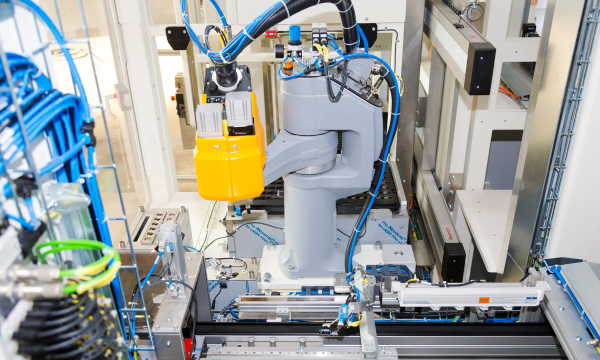
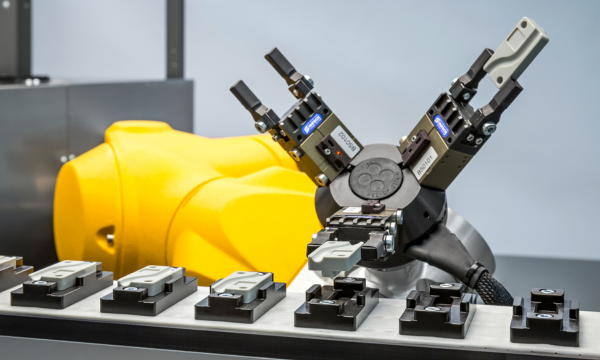
![[Translate to Englisch:] Automatisierte Montage mit Industrieroboter und Präzisionsgreifer – esmo automation](/fileadmin/user_upload/build-to-print-roboterzelle-automatisierung-esmo-automation.png "Automated assembly with an industrial robot and precision gripper – esmo automation")
![[Translate to Englisch:] Rütteltopf-Vereinzelung – Zuführungskomponente Montageanlage](/fileadmin/user_upload/Montageanlage-esmo-automation-Ruetteltopf-Vereinzelung.png "[Translate to Englisch:] Vereinzelung mit Rütteltopf in Montageanlage – esmo automation")
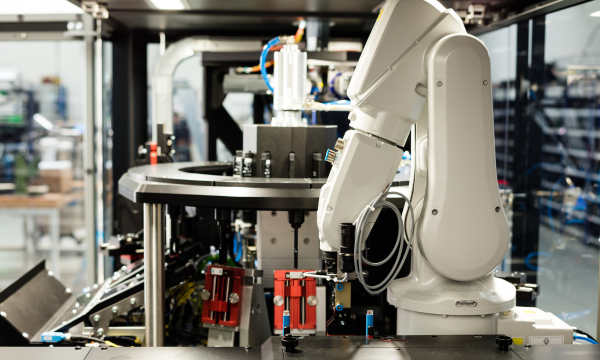
![[Translate to Englisch:] Automatisches Handling & Transport von Werkstücken – Montageanlage esmo automation](/fileadmin/user_upload/Montageanlage-esmo-automation-Handling-Transportieren.png "[Translate to Englisch:] Effizientes Werkstück-Handling & Transport bei esmo automation")
![[Translate to Englisch:] Fügen & Verbinden einzelner Komponenten – Montageanlage esmo automation](/fileadmin/user_upload/Montageanlage-esmo-automation-Fuegen-Einzelteile.png "[Translate to Englisch:] Präzises Fügen von Teilen – Montageanlage-Technologie")
![[Translate to Englisch:] AOI automatische optische Inspektion – Qualitätssicherung bei esmo automation Montageanlage](/fileadmin/user_upload/AOIT-Prueftechniken-automatische-Bildverarbeitung.jpg "[Translate to Englisch:] Automatische optische Inspektion – Testprozesse bei esmo automation")
![[Translate to Englisch:] Beschriftung & Codierung – individuelle Kennzeichnung bei Montageanlagen von esmo automation](/fileadmin/user_upload/Montageanlage-esmo-automation-Beschriftung-Codierung.png "[Translate to Englisch:] Kennzeichnung & Codierung in Montageprozessen – esmo autzomation Lösungen")
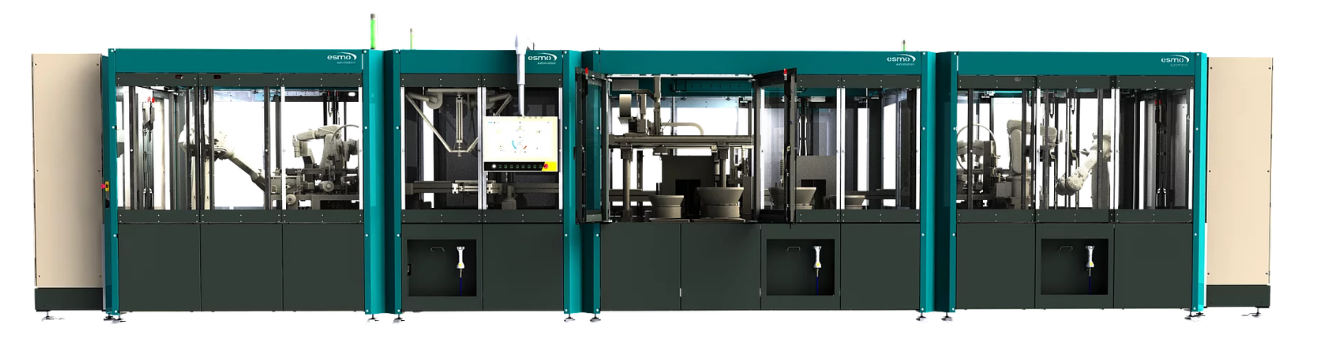
![[Translate to Englisch:] Montageautomat für Rückfahrsensoren bei esmo – automatisierte Montageanlage](/fileadmin/user_upload/Montageautomat-Rueckfahrsensoren.jpg "[Translate to Englisch:] Automatische Montageanlage für Rückfahrsensoren – esmo Technik")
![[Translate to Englisch:] UniCell Fertigungszelle – modulare esmo automation Produktionseinheit](/fileadmin/user_upload/Montageanlage-esmo-automation-UniCell-Fertigungszelle.png "[Translate to Englisch:] Modulare UniCell Fertigungszelle – effiziente Fertigungslösungen von esmo automation")